
Gladys was the first story I wanted to share for the obvious reasons in regards to my 19 year tenure at an early education center. 1985-2004. The next obvious entry has to be the beginning; Mission Statements.
Mission Statements sound boring? Right! Buckle up! I’m hoping to open your heart and mind to something totally different with the hope of expanding your thoughts! Let’s go!
I started Graduate School in 1986. Dr. Joan Isenberg was my first professor who taught me about the importance of having a Mission Statement. She encouraged her students to start with the Mission Statement! It’s a foundational piece of any early care and education program. It’s the underpinning of an exceptional center that supports the growth of our youngest children and the support of their families. Now here’s what’s really important. This important statement shows up in the budget. Who knew? I’m learning. Keep reading!
A mission statement for early childhood education
is a public declaration of the programs’s
purpose, goals and values. It’s a vital
part of any early childhood program,
and it helps guide the program’s staff and decisions.
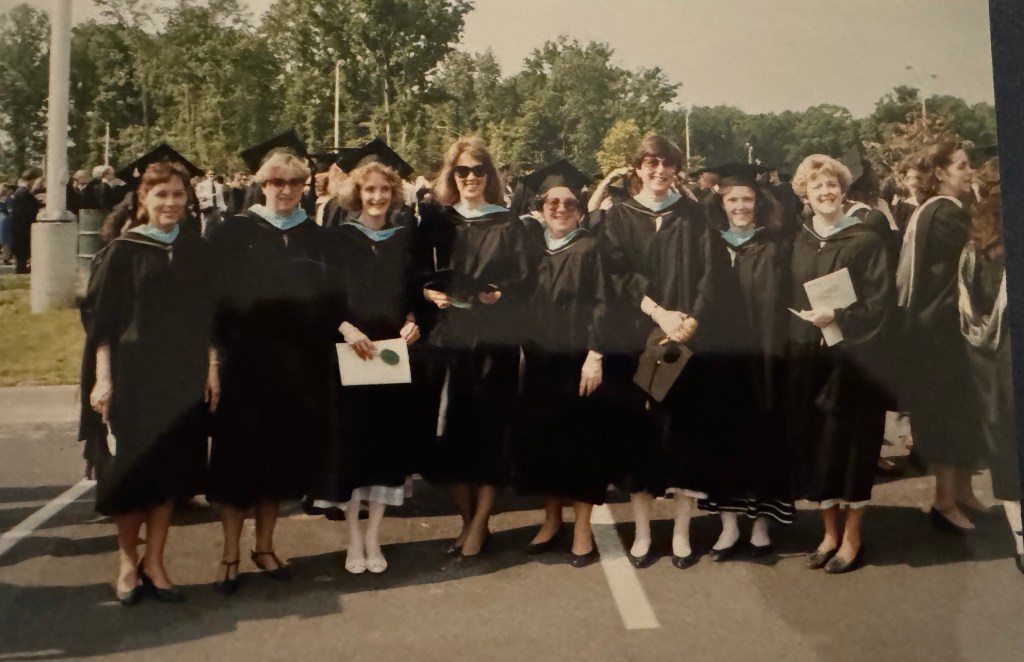
Masters Early Childhood Education
I remember reading the mission statement when I took the director’s position in June1985. It wasn’t inspiring. Thank goodness graduate school was my learning ground. I knew the mission statement needed more so I began to seek out other mission statements for inspiration which led me to think of other kinds of statements; vision and philosophy statements. Who knew? Each of these statements are different and provide different information for parents and teachers. I came to the conclusion that all of these statements were needed. They go deeper and provide more information, direction. Did I mention the budget and how connected they are? The budget is another blog!
I began to think about all the stakeholders in the school. The church school committee was obvious and in place. But who didn’t have a voice yet? What about parent’s voices? What about teacher’s voices? Wouldn’t it be powerful if all three voices came together with one resounding voice of “what’s good for children?” And I began to put a plan together in my brain, a vision!
And then boom! I came up with this idea that seemed to work. Each person in whichever committee was instructed to get a piece of paper, draw a square and write “child” in the middle of that box. Each meeting began this way to remind us of our duty to each child.
Every decision that was made
would be around this.
“What’s good for children.”
Period. It’s that simple!
I created a Parent Committee in 1986 that would advise me and support the school. I needed the consent of the Church School Committee. The parents’ voices proved to be invaluable in securing necessary items in classrooms that the budget wasn’t able to support.
I began to study the challenge of running a quality early care and education center while juggling the cost of quality early childhood environments, equitable compensation for teachers and affordable tuition for families otherwise known in the ECE World as QCA.
Quality
Compensation
Affordability
Attending Virginia’s state early childhood conferences and the national conference proved to be invaluable. VAAEYCand NAEYC QCA is much like a three footed stool that works best if all the legs are even.
Challenging is the word.
Educating the Church School Committee,
the parents and the teachers
became MY mission.
The first Vision Retreat was held in the Spring of 2000. The church, the teachers and the parents wrote a belief system regarding discipline, curriculum and professional standards. A Vision Statement was written as a result of this event. It was adopted in June 2000. New relationships were established between all three groups. I only wish I had kept up with how many hours were engaged.
The next Vision Retreat was held in March 2003. This time I wanted to dive deeper into the issues regarding Quality, Compensation and Affordability. I believe this retreat was a success in that all parties in the room began to understand the predicament; the complexities. The bonus was that Tom Hunter flew in from Bellingham, Washington, to be the moderator.
I met Tom Hunter in the Fall of 2002 when the school closed for three days to allow the entire faculty to fly to Sacramento, California for a conference led by Bev Bos at Roseville Community Preschool. Tom was a part of the training.
When all the stakeholders voices are heard, children are the winners.
Here’s a short list of the benefits from our mission and vision statement creation over my tenure:
- The purchase of wooden blocks for each classroom. It’s a great story that involves the new Parent Committee. And we bought a lot of blocks! 1986
- The annual Faculty Retreat began with closing the school in order for all the faculty to gather in a West Virginia retreat center to learn and play together. 1986
- The decision to work towards accreditation through NAEYC. I look forward to writing about our work! 1992
- The journey into the school becoming an inclusive preschool. The school was privileged to be asked to participate in the Community Connections Project with The George Washington University. What an opportunity to learn how to intentionally include children with special needs. 1995-1996
- The building of an outdoor classroom. I really am looking forward to writing about how teachers, parents and the church came together to build a beautiful outdoor classroom. 1995
- The discovery of Conscious Discipline and then hosting Dr. Becky Bailey at the Preschool.
1998 - 15 teachers flew to Sacramento to study with Bev Bos. I look forward to writing you about how this all came together for ALL children. 2002
- And then there are the human stories all along the way. I look forward to sharing those stories via my blog.
So where’s the sweet spot?
I began this blog with the word boring. Remember the opening line?
My 19 year journey was anything but boring. I believe that the mission statement, vision statement, philosophy and purpose statement were my road maps to “what’s best for children.” Oddly enough that can be hard for folks that aren’t children and yet those folks understood this powerful thought and we put it into action.
Are you willing to put children first in your early care and education program? Identify your fears and face them. You won’t regret it. I didn’t.
It begins and ends with
“what’s good for children.”
Period
So I really want to hear from you.
What’s your experience?
Are you willing to bring the stakeholders together and begin the hard work?
Write me your questions.
“Children are miracles.
Believing that every child is a miracle
can transform the way we design for children’s care.
When we invite a miracle into our lives,
we prepare ourselves and the environment
around us. We may set out flowers
or special offerings. We may cleanse ourselves,
the space, or our thoughts of everything
but the love inside us. We make it our job
to create, with reverence and gratitude,
a space that is worthy of a miracle.
Actions follows thought.
We can choose to change.
We can choose to design spaces
for miracles, not minimums.”
Anita Rui Olds, 1999

 Living In the Sweet Spot
it was a long wonderful journey. It changed my life.
LikeLike